



Skip to content

    The Material Hub Vision: The Future of Material Management

    Unifying Material Decision-Making Across Owners, Architects, Contractors, and Manufacturers

    AUTHOR
    David Lemont 
    Executive Chairman, Acelab · Former CEO, Revit

    Our Mission

    Materials are the soul of every building. The right choices mean structures that endure, achieve sustainability goals, and perform efficiently. The wrong ones lead to deterioration, compromised sustainability, and excessive operating costs. Yet despite representing over 40% of building costs and fundamentally shaping every building's success, material decisions remain compromised: the stakeholders who must collaborate—architects, designers, owners, contractors, and manufacturers—work from disconnected information, fragmented systems, and stale or incomplete data. The construction industry loses $1.8 trillion annually due to poor data management, and material decisions remain trapped in silos despite their outsized importance to project success.

    This requires a fundamental shift. We've built the industry's first unified material management platform—a common platform where all stakeholders access the same comprehensive material information, work from shared standards, and collaborate through integrated tools. Our vision is material-forward design: integrating material intelligence directly into the design process, so architects make better decisions while designing—with documentation flowing automatically. When owners establish sustainability requirements and portfolio standards, architects research performance criteria, contractors verify availability and weigh in on installability, and manufacturers connect their products to active projects, they're all drawing from the same foundation of truth—working together in real-time rather than passing disconnected documents. Decisions propagate instantly across specifications, drawings, and schedules—saving hours of coordination time and ensuring accuracy and efficiency.

    When project teams make material choices driven by comprehensive intelligence and finally speak the same language about materials, we create more cost-effective buildings, perform better, achieve meaningful sustainability goals, and realize the full vision of great design.

    Our Solution: Material Hub—Where Data, Workflow, and Standards Unite

    Acelab's Material Hub creates the missing infrastructure the industry desperately needs by uniting three essential elements that have never existed together in one system:

    1 icon - green-2
    A Common Data Backbone

    Our comprehensive common language of materials captures every critical dimension of building products—technical performance, aesthetic properties, sustainability intelligence, building code compliance, local building and energy codes, economic data, product documentation, manufacturer connections, and real-world performance feedback. Every stakeholder works from the same complete, accurate information.

    2 icon - green-1
    Standards-Based Foundation

    Every organization has institutional knowledge about materials—preferences proven through years of projects, products that consistently perform, and solutions that align with their values. Material Hub transforms this scattered knowledge into a living repository. Owners maintain portfolio-wide standards, architects establish their basis of design, and contractors access the reasoning behind specifications—all organized, searchable, and continuously enriched. These standards become the starting point for every new project, ensuring consistency while enabling teams to discover better solutions.

    3 icon - green-1
    Collaborative Workflow Tools

    Material Hub provides an integrated environment where material decisions actually happen. From AI-powered search and product comparisons to approval workflows and automated documentation generation, every stakeholder has tools to research, evaluate, discuss, and document efficiently. When an architect researches options, an owner reviews selections, a contractor weighs in on installability and maintenance, or a manufacturer responds to inquiries, they work together in the same environment with access to the same AI search tools, library standards, and requirements.

    These three pillars create a platform where material intelligence finally becomes actionable—the right information, the right tools, and the right foundation to make better decisions together.

    The Material Intelligence Backbone: Why Comprehensive Data and AI Matter

    Material Hub tracks over 200,000+ products from 8,000+ brands, monitors 2,000+ certifications, catalogs performance across 200+ technical attributes and 60+ aesthetic characteristics, and maintains alignment with 30+ building and energy codes. This universe grows daily as manufacturers introduce innovations, certifications evolve, and sustainability requirements advance. We continuously expand and refine this foundation, adding new products, updating certifications, and enriching product data to ensure the platform reflects the latest industry developments.

    200k products
    8k brands
    2k certifications
    200 tech attib

    Firms that build their own material libraries face an impossible maintenance challenge. What took months to compile becomes outdated within weeks. Material Hub keeps all this data current and accurate in one central location, automatically reflecting changes across the industry as they happen.

    Our AI assistant lets you interact through natural language: "I need exterior cladding for a coastal environment that meets LEED Gold requirements and stays within budget." The AI understands context, interprets requirements, evaluates performance, considers sustainability criteria, and surfaces solutions—while explaining its reasoning.

    This transforms every team member into a material expert. The AI understands how products perform in real applications, how they align with your firm's basis of design, how they meet project constraints, and how they compare across multiple dimensions. Material intelligence that once took hours becomes instantly accessible and clearly explained.

    Breaking Down Silos: Unified Workflows From Decision to Delivery

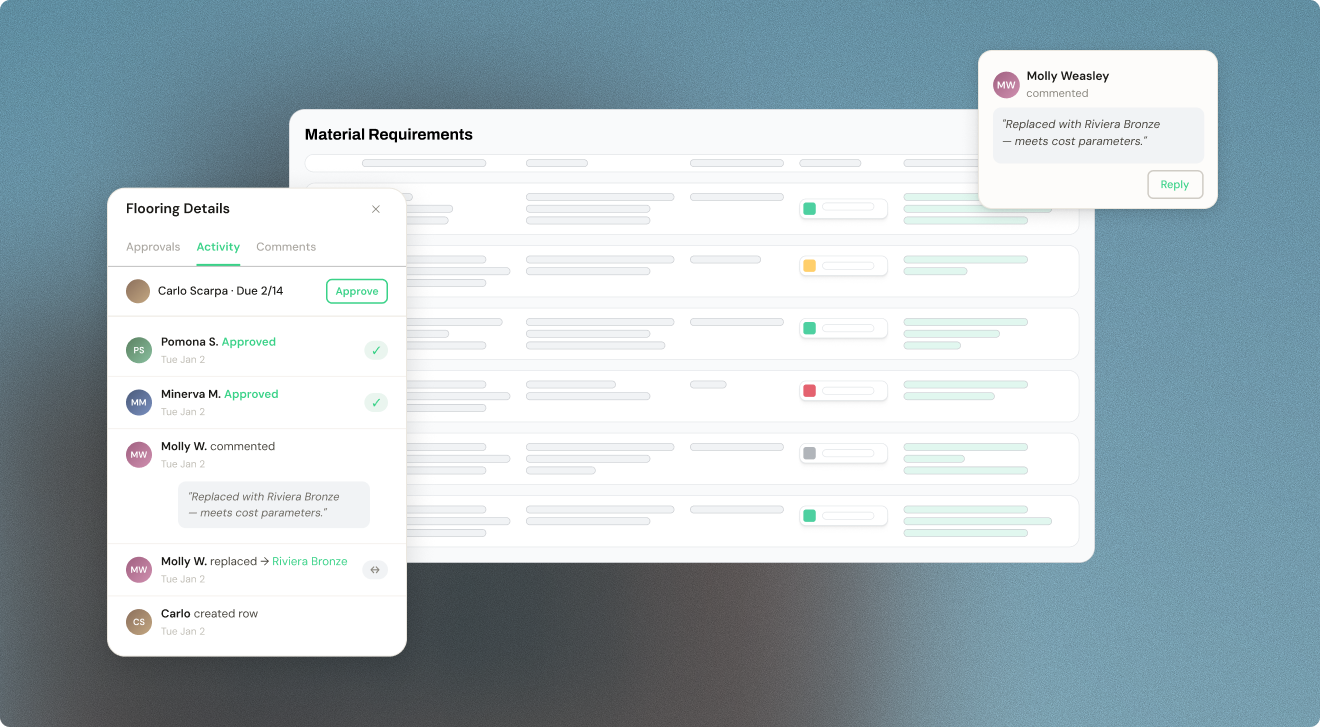
    Consider how material decisions typically unfold: An architect specifies a window system, drawing from past specs and scattered web searches. The owner reviews the submittal without access to complete certification data, embodied carbon metrics, and performance specifications—they approve it, trusting the architect's judgment.

    During construction, supply chain issues force a substitution. The architect updates the specifications but not the drawings. The owner isn't notified. The contractor, facing inconsistent documents and lacking access to original requirements, wastes time trying to understand what criteria the substitution must meet. Meanwhile, a manufacturer with a superior product never knew this project existed.

    Flooring Details

    Material Hub changes this by connecting all stakeholders through shared intelligence and transforming material decisions into reusable documentation assets. Each decision contains comprehensive product data that automatically generates whatever documentation each stakeholder needs. 

    Owners Set Standards and Control From the Beginning

    Owners define portfolio-wide material standards—living connections to comprehensive product data, sustainability criteria, and performance requirements that flow directly into projects. When architects explore alternatives, owners see decisions with complete context: performance data, sustainability metrics, cost implications, and code compliance. Portfolio management becomes strategic rather than reactive.


    Architects and Designers Build on Owner Standards to Create Projects 

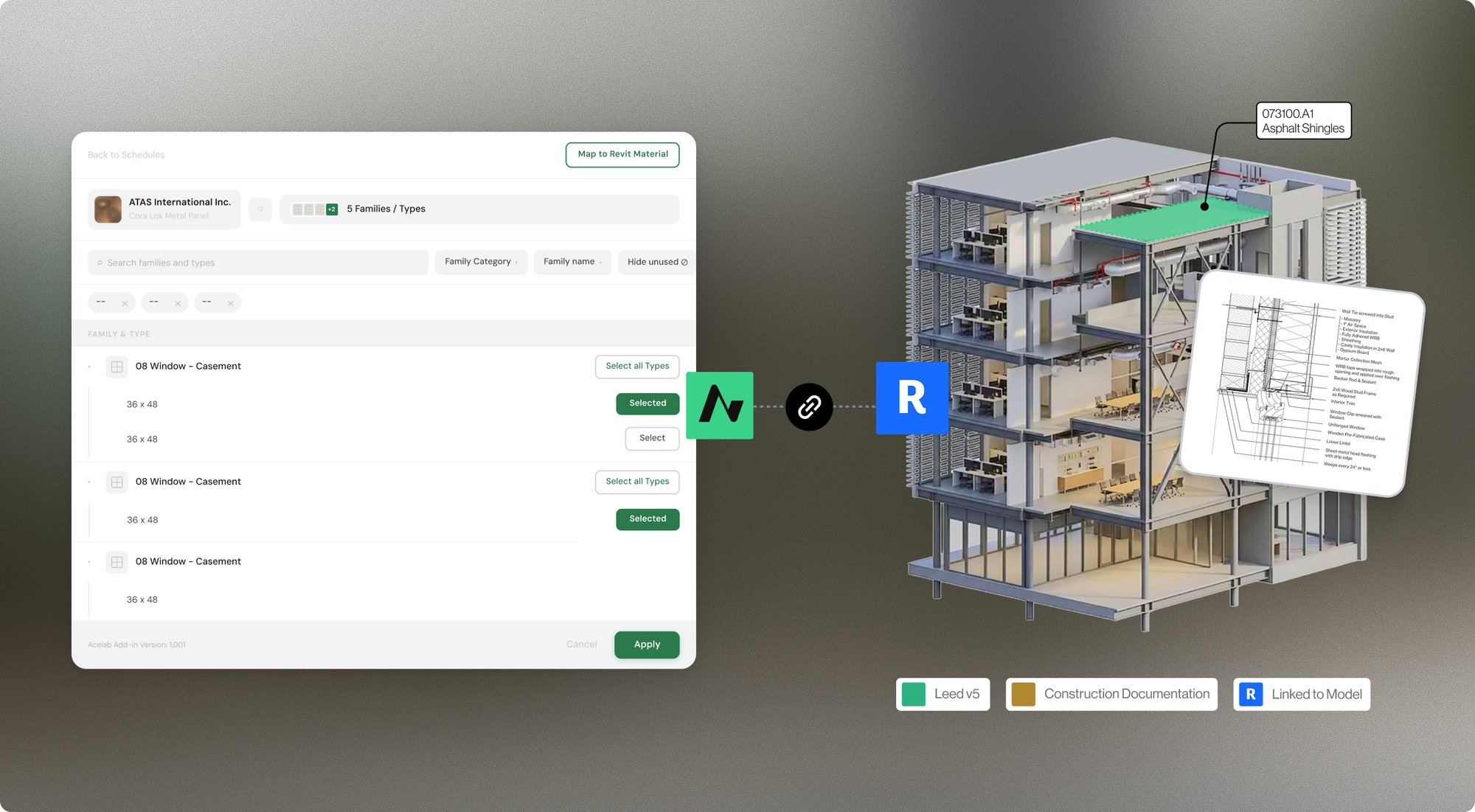
    Architects link Revit building elements to Material Hub, connecting design to intelligent material data. Material selections automatically flow into keynotes and tags. When keynotes update automatically as material decisions change, the industry-wide problem of keeping product data synchronized with drawings is solved. Those decisions generate schedules, specifications, material pledge reports, embodied carbon analysis, and cost estimates—freeing architects to focus on design.


    Contractors Work From Certainty, Not Assumptions

    Contractors access the same platform, seeing standards, requirements, and design intent directly. When substitutions are necessary, they access the reasoning behind original decisions. Using the same data and AI tools architects use, they identify alternatives that truly match intent. With direct access to pricing, availability, and manufacturer contacts, contractors can quickly get bids, procure materials, and purchase products directly from the schedule—streamlining the entire procurement process. They produce submittal packages, cut sheets, as-built documentation, and warranty tracking without hunting through multiple sources.


    Manufacturers Connect at Decision-Making Moments

    When architects research materials, Acelab's AI surfaces products based on technical fit—and manufacturers can engage directly during active decision-making. As products enter firm libraries and portfolio standards, manufacturers become the basis of design for future projects. Innovation reaches receptive audiences, proven performance builds institutional knowledge, and lasting relationships develop.


    Material-Forward Design: Seamlessly Integrating Intelligence Into the Design Process

    Our vision is to integrate material selection deeply into design itself—making intelligent material choices seamless, quick, and automatically documented. This is material-forward design: where all the information needed to make the best decisions is available at the appropriate moments.

    Imagine a designer working in Revit who places an interior door family. That element is tagged with material requirements—performance criteria, sustainability goals, budget constraints—but not yet linked to a specific product. The design continues.

    Later, when it's time to decide, the designer searches their firm's library for the standard door or explores Material Hub's database for alternatives. Acelab provides swatch information showing available colors and finishes. The designer renders the interior space, evaluating aesthetically which choice works best. Simultaneously, they analyze embodied carbon impact and other performance considerations—fire ratings, acoustic properties, durability metrics—because all material information and calculators are at their fingertips.

    When the product is chosen, material links update automatically. Keynotes are generated in Revit schedules with accurate information. The same data flows into specifications. Drawings, schedules, and specs reflect the same decision, coordinated perfectly. If the designer later changes their mind, that change propagates instantly across all documentation.

    This is material-forward design: designers make better decisions faster because comprehensive material intelligence is integrated into their workflow at precisely the moments they need it. Everything flows naturally from the design process itself, with material intelligence enhancing creativity rather than interrupting it. 

    graphics 3

    The result: buildings that better realize the designer's vision, meet the owner's sustainability goals, stay within budget, and are documented with perfect accuracy.

    The Compounding Effect of Shared Material Management Intelligence  

    The true power of Acelab emerges from the compounding value of shared intelligence across thousands of projects and firms. Each material decision captures lessons learned—installation successes, performance outcomes, substitution experiences—that enrich the common data backbone for everyone. Architects learn from their peers' real-world experiences. Owners build increasingly sophisticated standards. Contractors move faster with direct access to the owners' and architects' thinking. Manufacturers become true project partners, providing expert guidance that helps teams optimize material choices for performance, budget, and sustainability.

    Join the Movement

    We recognize that building the right platform requires deep collaboration with the experts who do this work every day. We measure our success not by features shipped, but by hours saved, errors eliminated, and better buildings delivered. We believe material management technology should evolve through ongoing dialogue with the people who rely on it. Your feedback shapes our roadmap. Your challenges inform our priorities. Your successes validate our direction.


    The future of building requires a common foundation—unified data and collaborative tools that make better material decisions possible.


    Material Hub provides that foundation. When all stakeholders work from the same platform, speaking the same language about materials and sharing the same intelligence and standards, the fragmentation that has plagued construction for decades dissolves. Better decisions happen faster. Projects run smoothly. Buildings perform better and achieve meaningful sustainability goals.

    Whether you're an architect, owner, contractor, or manufacturer, your expertise strengthens this ecosystem. Your participation makes the platform more valuable for everyone.


    Welcome to Acelab's Material Hub. Let's build better — together.

    Acelab logo - for material hub