

Change orders do not start in construction. In fact, they do not start in preconstruction either. They start when the material decisions are being evaluated, or made badly, or not made at all.
The first is a material that gets selected. What it costs is knowable. Whether the budget can absorb it is never asked.
The second is a material that gets selected and specified, priced and drawn, but never checked against your brand or sustainability standards but relied on outdated material specs. It is a correct decision on paper and a violation of what you set out to build.
The third is a material that never gets specified at all, so it is not in the drawings, not in the estimate, and not in anybody's bid.
Two of these put you over budget. The one nobody priced moves your number. The one nobody specified pushes you past it, because you cannot review something that was never written down. The third costs you differently. A material that quietly misses a brand or sustainability standard does not show up as a number at all. You find out later, and putting it right once the project is underway is its own change order or may result in higher maintenance and operational costs after construction.
You have been in this meeting.
Bids come back, or the GC delivers the GMP. The number is over, and it is over by enough that nobody wants to say it first. Then the search starts. Somebody pulls up the finish schedule. Somebody else opens the spec.
Inside of half an hour you learn that the cladding assembly the team settled on during design development carries a number nobody analyzed against the budget, that the spec section and the drawing do not describe the same product, and that the contractor bid the more expensive reading of the two.
None of that is new information to the project. It is only new to you.
Back to the Drawing Board
Did the project begin with a written set of material standards, or did it begin with a reference project and a set of preferences that lived in people's heads?
Were the design architect, the architect of record, and your owner's rep all working from one recorded set of material selections, organized by area of the building, that you could open and understand at a glance?
When the team narrowed a facade assembly from three candidates to one, did you see the three? Or did you see the winner, after the decision was made, in a rendering?
Who checked that every interior finish was selected, added to the schedules, and held against the standards your past projects taught you?
At any point before bid day, could you have answered the question of whether what was being selected matched what you set out to build?
Every one of those questions has the same answer, and it is no. Not because anyone was careless, but because there was no single place where a selection could be checked against your standard, your budget, and what your past projects taught you. The information existed. It was scattered across specifications and drawings, and those are instruments an architect writes for a contractor. You were never the intended reader.
So you approved by trusting the team. That is not a criticism of the team. It is what happens when there is no shared platform and process holding the decisions in one place that ensures your participation in early decision making with clear visibility of options being analyzed and evaluated.
Then comes the part that costs real money. Value engineering runs under time pressure, and the standards go first, because standards are the least documented thing in the room. Long lead items get re-selected and re-approved. The architect redesigns work that was already finished, and bills you for it. Every one of those becomes a change order.
And you call your lender to explain why the budget you underwrote is not the budget you are building. An overrun is a number. A re-forecast is a credibility event, and it follows you into the next deal.
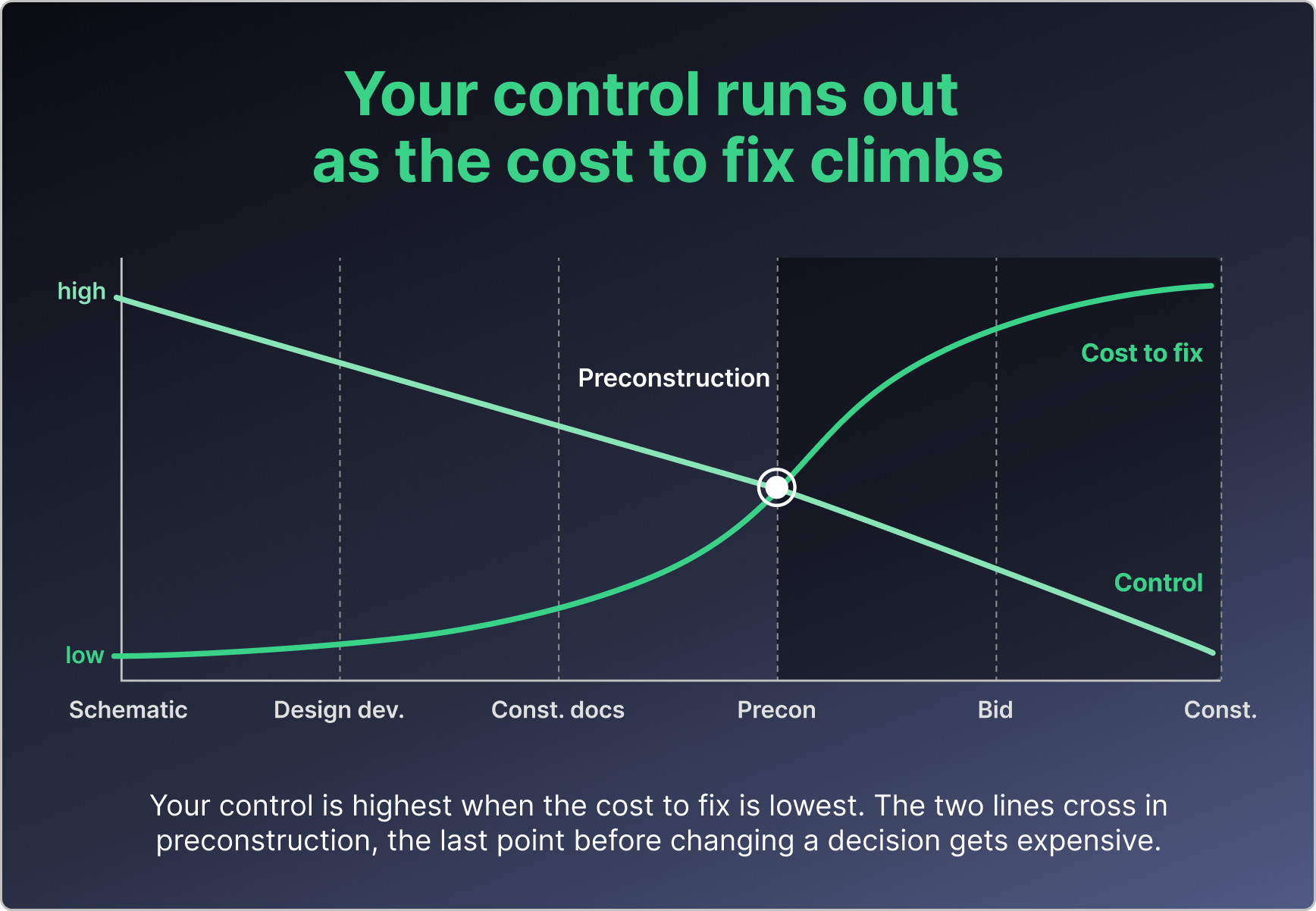
Here is the structure underneath all of it. Across the phases of design, from schematic through construction documents, your control falls while the cost to fix climbs. Early on, changing a material package costs a conversation, because nothing has been detailed, bid, or ordered. By the end, the same change means reworking a coordinated set of drawings, and every hour of it is billed to you.
The two lines cross before you ever see a bid. That crossing is the last point where a material decision is still inexpensive to change. On most projects, it passes unmarked.
Specs and Drawings Answer the Contractor’s Questions, Not Yours
Ask an architect for the material information on a project and you will get it: a specification, a set of drawings, a finish schedule, a submittal log. All of it accurate, all of it built to tell a contractor what to buy. None of it built to tell you what you are buying, whether it meets your standard, or what it costs against your budget.
This is why design reviews feel productive but miss the decisions that cost you. You are shown renderings and samples, so aesthetics get discussed. Cost, standard compliance, and the alternates that were passed over are not in the room, so they do not come up. You approve the look and inherit the rest.
Every material decision does eventually become fully visible to you, priced, coordinated, and checkable against your standard. That moment is the bid. It is the first time the entire material package appears in one place with numbers attached, and it arrives after the last point where changing any of it was inexpensive.
Then it happens a second time. A product goes on allocation or a lead time slips, and a substitution request lands during construction. You are being asked to approve a swap against an original selection you never saw the reasoning for, on a deadline, with the crew already mobilized. Decisions need to be fast so construction can keep moving forward or you will be billed for delays in schedule.
The problem is not that you lack information. By bid day you have all of it. The problem is that it arrives in the order that suits the documents rather than the order that suits your decisions.
There is a version of this where you are in the room earlier. Not reviewing selections after the fact, but present when the requirements are set, working from the same information as the team. That requires a process. It also requires a tool, because the process cannot run on documents built for someone else.
There is a strategy for working this way. Material intelligence.
Your Standards Become the Starting Point of the Project
Material Hub is the material intelligence platform, where material decisions get made, reviewed, and recorded. Everyone with a stake in a material decision works in the same environment, on the same selections, with the same information in front of them.
It starts with your standards.
Today your standards are a document you send at kickoff. Brand requirements, quality expectations, approved manufacturers, sustainability targets. It is read once and then it sits in a folder while the actual decisions get made somewhere else. Nobody is checking against it, because checking would mean opening two files and comparing them by hand, several hundred times.
In Material Hub, your standards are not a document. They are a living digital library of decisions that can be evaluated and establish approved products with required performance levels, sustainability thresholds, and preferred vendors. When a project starts, that library loads into it, so the team designs from your standard rather than being measured against it afterward. A selection that falls outside the library is flagged as it is made, not caught months later.
And each requirement carries the intent behind it, so the team understands why it is there, not just that it exists.
This means the design architect is not guessing what you will accept. Your requirements are visible while they are designing, not after.
On a large development project that team is not one party, and the gaps between the parties are where material decisions go wrong. The design architect makes the selection. The architect of record documents it, details it, and carries the liability for it. Your owner's rep is accountable for whether it matches what you set out to build. The contractor has to buy it, sequence it, and install it.
Today they work in sequence, each picking up a decision the one before them already made, often without seeing why.
In Material Hub they work on the same common platform, on the decision as it is being made. When the design architect selects a facade assembly, the architect of record, the owner's rep, and the contractor are looking at the same selection while it is still a proposal. Cost, installability, maintenance, performance, and sustainability all get weighed at once, by the people who own each of them, instead of one at a time as the decision passes down the line.
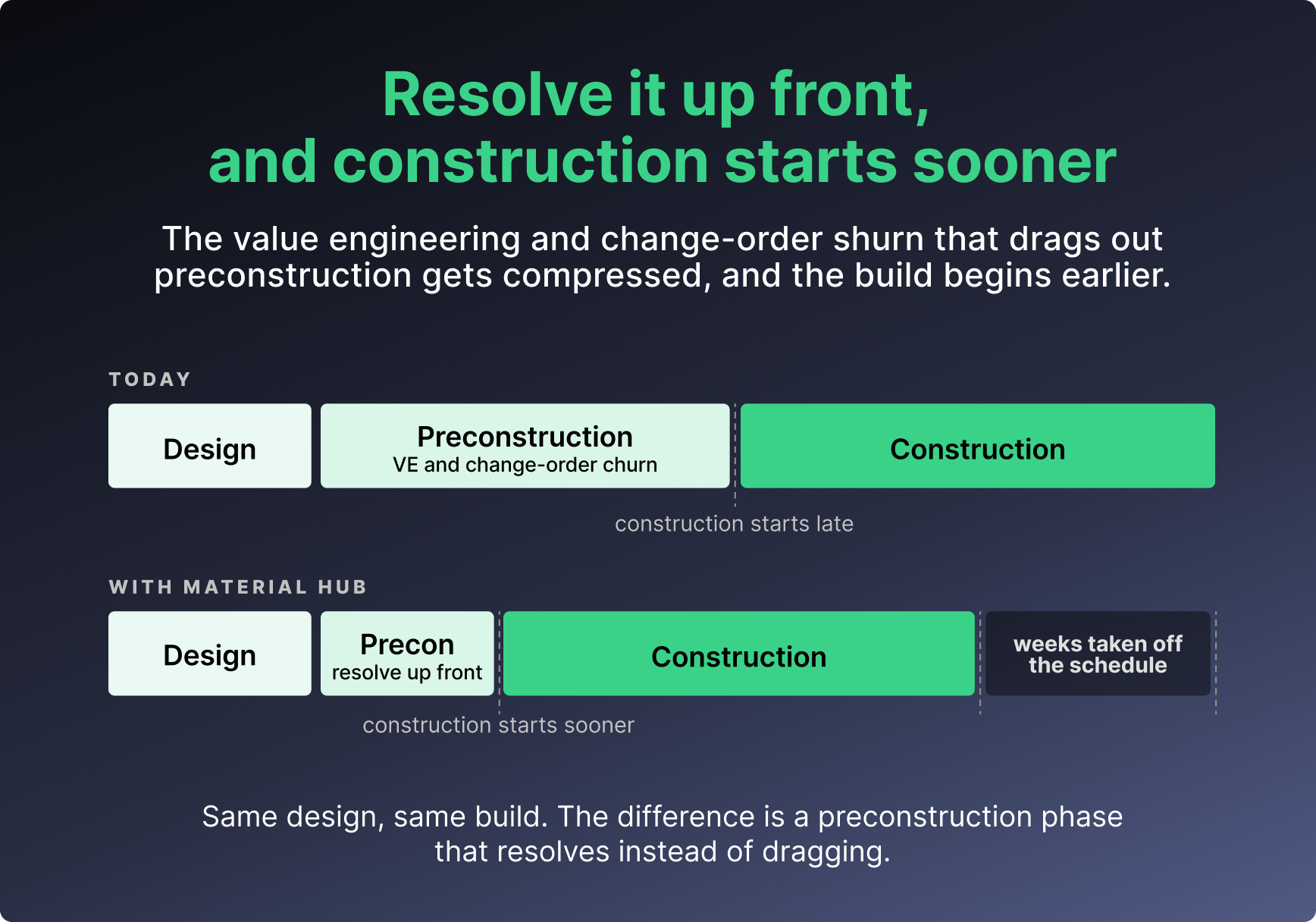
That collaboration is what dramatically reduces the value engineering that would otherwise land on you later. The judgment that used to happen in preconstruction happens during design, when there is still room to act on it.
Every decision carries its reasoning. Not the winner alone, but the field it beat and why it won. When somebody asks in month nine why this product, the answer is in the record, not in an email thread or someone's recollection.
From there, four things you have never had.
First, one material register for the whole project, organized by area of the building, always current. Not a schedule someone exports on Fridays. Open it on any day and read exactly where things stand, with the full history of every change and the commentary behind it logged in place. This empowers the team to ask the right questions early to explore alternate options during design.
Second, every option, not just the winner. Each decision keeps the alternates that were considered, with their performance data and sustainability profiles, and the reason the winner won.
Third, budget impact at the point of selection. The contractor, working in the project during design, adds cost to a selection as it happens, so the team sees where it lands against the budget while the decision can still change. With early collaboration subs can weigh in to offer suggestions that meet performance and budget requirements. This ensures that material decisions are being evaluated systematically and not on a one by one basis to make the budget work later.
Fourth, a record that builds itself. Every selection, substitution, and approval logged with who decided it and when. Nobody assembles it at closeout, because it was never scattered.
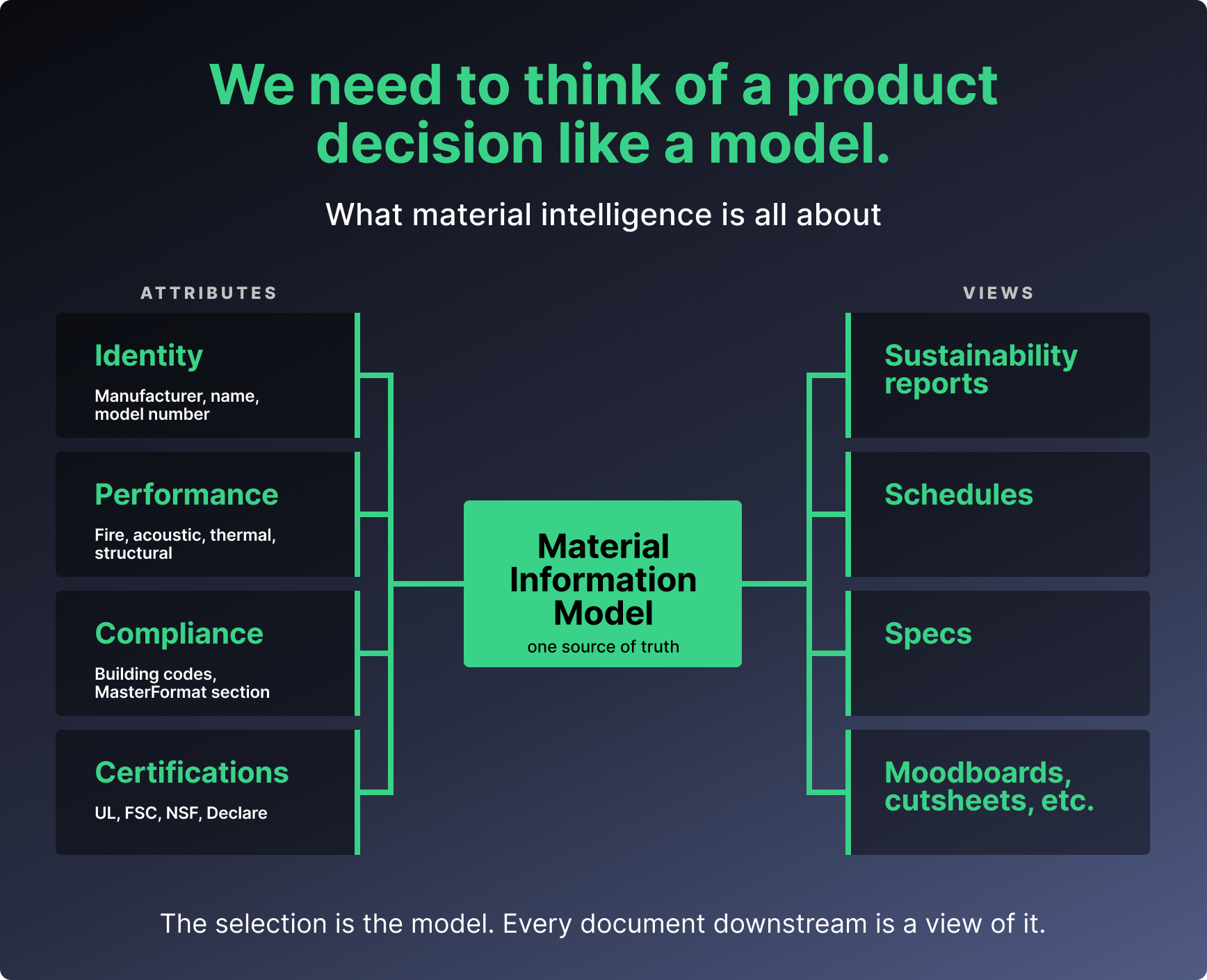
The mechanism underneath all of it is the Material Information Model. Every product selection carries its full attribute set, so specs, schedules, keynotes, drawings, and reports are all views of the same decision. That is what material intelligence means, and it is the same principle that let Revit coordinate geometry twenty years ago, applied to materials for the first time.
Change the selection once, and every downstream document follows: the specs, the schedules, the Revit drawings, all in sync, so the conflicts that turn into RFIs and change orders never get created.
Find What Is Missing While It Is Still Free to Fix
That visibility does something you cannot do today. It lets the team find what is missing.
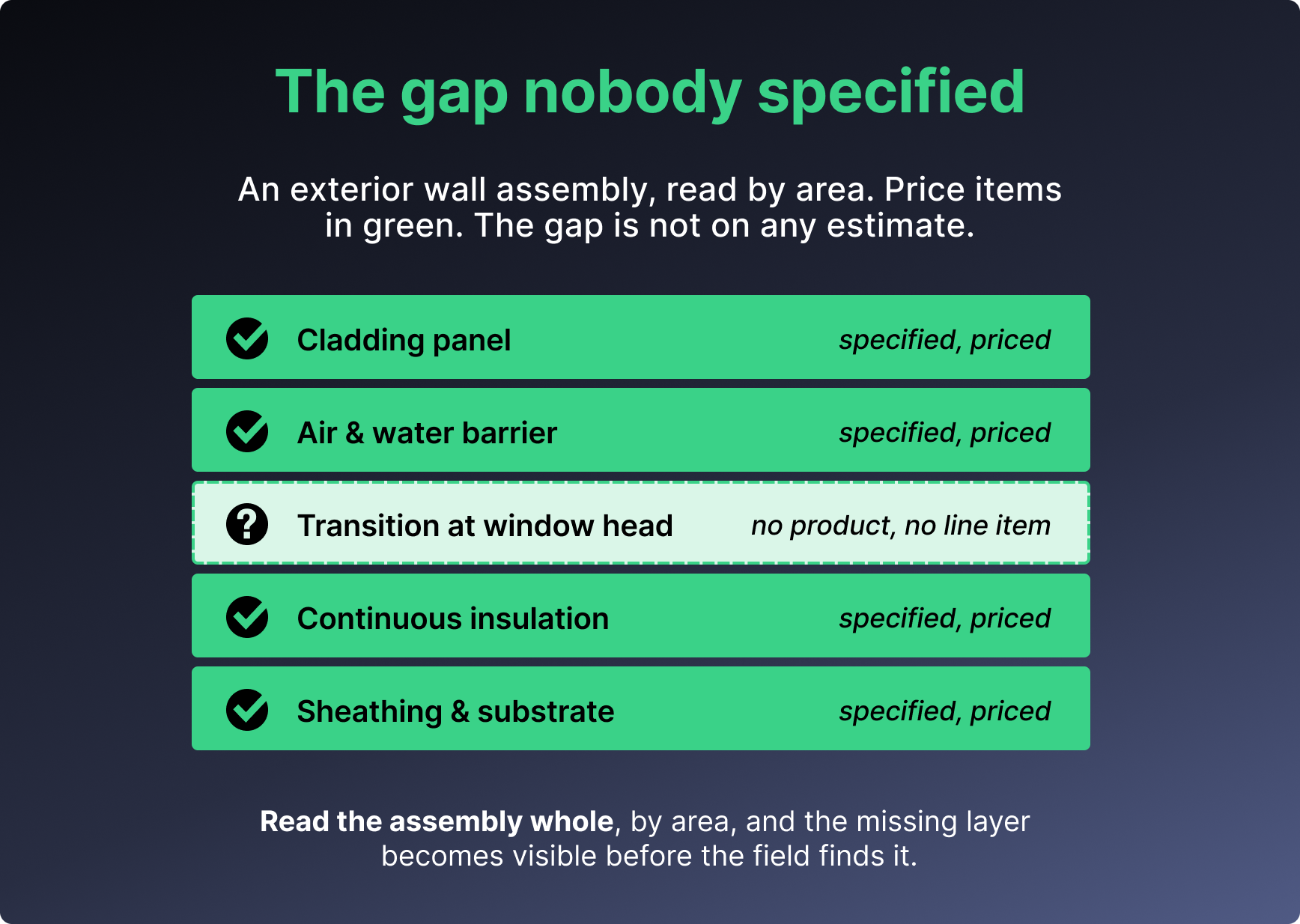
The failure this catches is not a decision that went wrong. It is a decision nobody made. A transition detail with no product behind it. Scope that falls between the design architect and the architect of record because each thought the other had it. None of it appears on an estimate, which prices only what was specified. It shows up in the field, as a change order, because somebody has to supply it.
You catch it by looking at the whole set of decisions by area of the building, with the people who have built before looking alongside you. A contractor reads a wall assembly and knows at once what is not there. That expertise is already on your team. It has never had anything to look at, because the decisions live scattered across five document types held by four parties.
Put the full set in front of them during preconstruction and the gaps become findable while they are still free to fix.
This is where change orders get eliminated instead of managed. A gap caught in preconstruction is a five-minute fix. The same gap found in the field is a change order, a schedule hit, and a markup. Closing them before the build starts is the single biggest thing you can do to protect your budget.
Value Engineering Against Requirements, Not Just Price
Value engineering is often a necessity. Budgets tighten, a product goes to a long lead time, a supply chain seizes up, and a selection that made sense in design has to change. The question is not whether it happens but whether you can see what you are trading when it does.
It is a trade between cost and requirements. Material Hub puts both in front of every party making it.
The requirement travels with the selection. When the contractor opens a product, he sees what it has to do: the performance thresholds, the certifications, the sustainability targets, your standard. He is working the cost down against the actual criteria rather than against a price line alone.
He searches the same catalog the architect searched, across 250,000 products and 2,000 certifications, with AI that reads the project context and the requirement and recommends the closest products that meet it. So the alternates that come back hold the requirement and hit the number, instead of one or the other.
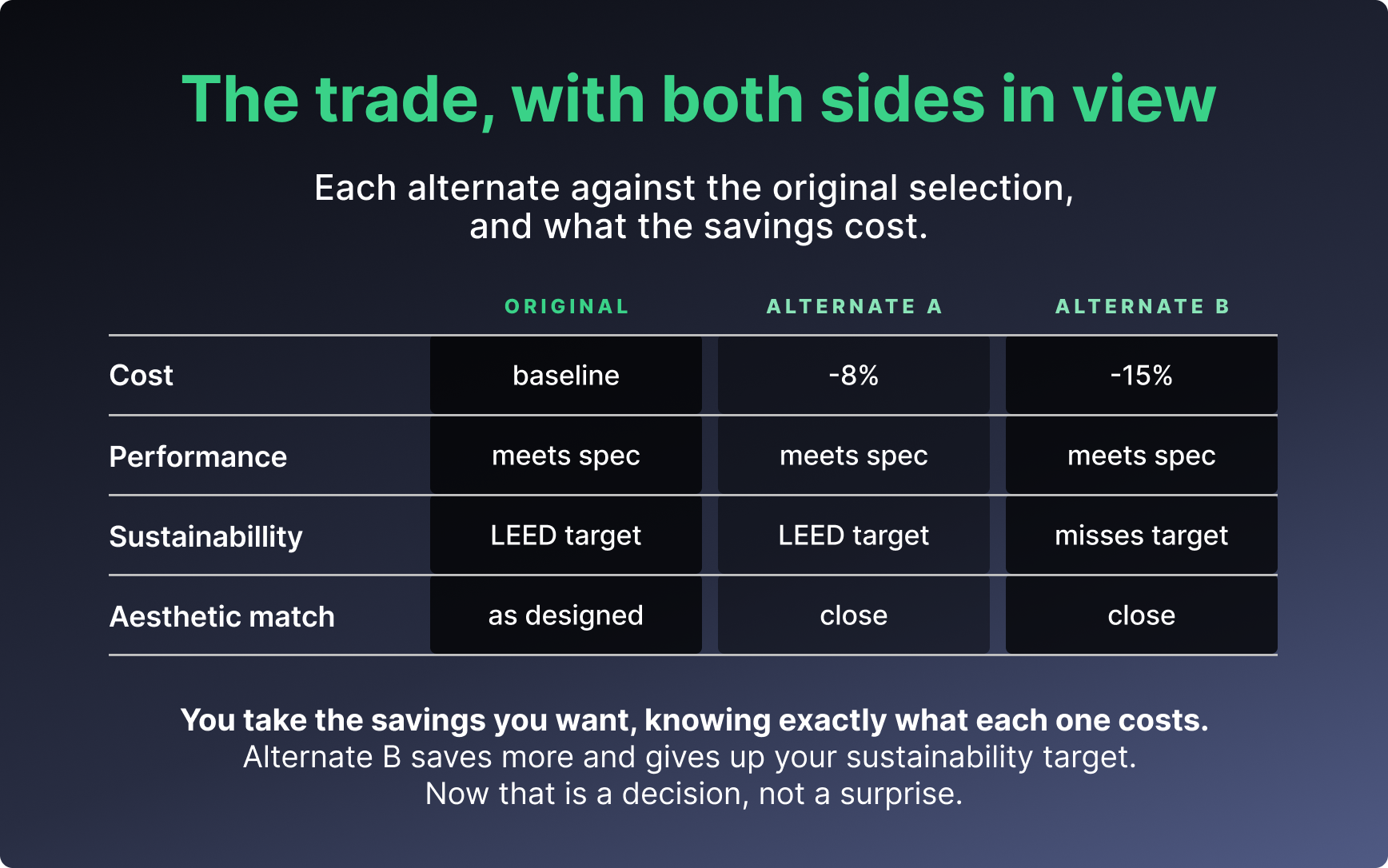
Then you see how each candidate sits against the original. Cost, performance, sustainability, and aesthetics side by side, with the deltas named. Real savings on the left, the specific gap it opens on the right.
You take the savings you want and you know exactly what each one buys and what it costs. The standards that get traded are the ones you chose to trade.
A Workflow for Decisions, and a Record of Every One
Every material decision sets off a chain of questions, reviews, and approvals. Without one place to hold them, that chain scatters across documents and email threads, and decisions stall because a request is sitting unseen in someone's inbox. Material Hub runs the chain as a workflow instead.
Discussion stays on the decision. A comment on a product is attached to that product, with the performance, cost, and sustainability data right beside it, so nobody argues from a number they cannot see. Approvals route from there. A request goes to the people who have to sign it, in order, each notified when it is their turn, with everyone able to see what is waiting on whom. The best decision is the easy one to make, and it keeps moving instead of sitting in an inbox.
All of that leaves a trail, and the trail is the part you will care about later.
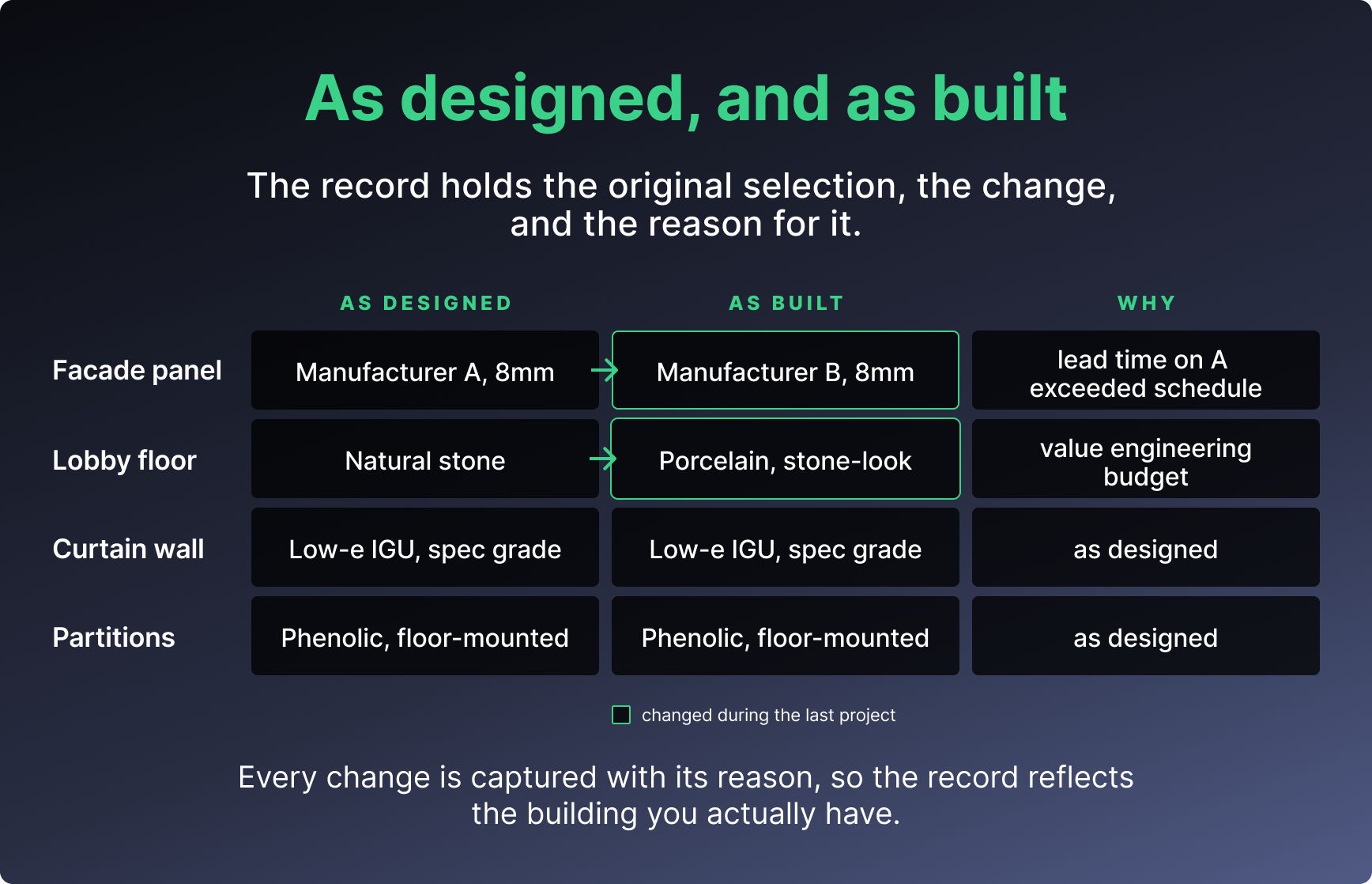
Every selection carries its own history. The requirement it was chosen against. The alternates that were considered. Who approved it, when, and what they were looking at when they did. Every substitution after that, with the reason and the sign-off.
Two years on, when a facade panel is failing or a floor finish is not wearing the way it was supposed to, you do not reconstruct that from memory and inboxes. You reopen the project in Material Hub and read what happened. Which requirement was set, what was selected against it, who changed it and why, and what the manufacturer represented at the time.
That record settles the question of what was agreed and when. It supports a warranty claim, a dispute with a trade, or an insurance conversation, and it does it with evidence rather than recollection.
Nobody assembles it at closeout. It was built as the project was built.
You Finish With a Record of the Whole Build
The project ends with something you have never had at closeout. A full account of what went into the building. Every material, where it is, what it has to do, who made it, what it cost, and why it was chosen over the alternatives. Every product data sheet with complete closeout documentation is all available in one place.
That record runs the building. When a finish needs repair or a warranty needs filing, your operations team opens the Material Hub project and finds the manufacturer, the spec, and the rep, instead of digging through closeout files that were out of date the day they arrived.
And it holds everything the project learned. What performed and what you replaced. What held its budget and what ran over. Which requirements earned their place by preventing problems before they reached the field.
That learning is the starting capital for the next project.
The Next Project Starts From Everything the Last One Knew
You open a new project in Material Hub and set its standards and goals first, drawn not from a blank page but from the material intelligence the last project recorded: approved products, required performance, sustainability targets, the requirements that earned their place. Everything that project learned is already in front of you.
The value is in what the last project taught you, now written into the standard so the next team cannot miss it.
A product that ran over budget becomes a note on that product, so it is priced with eyes open next time, or not proposed at all. A finish that did not hold up in a high-traffic area becomes a maintenance flag, so it is not specified there again. An assembly that kept generating RFIs because a transition detail was always missing becomes a required line in the standard, so the gap is closed before design starts.
A long-lead product that forced a substitution becomes a lead-time warning attached to the selection.
None of that lived anywhere before. It left with the team, and the next project rediscovered it the hard way, as a change order or a value engineering cycle. Now it is in the standard, and the next project starts having already learned it.
You deliver a better project. Fewer change orders and less value engineering, because the gaps that cause them are closed and their costs are visible while decisions can still change. A budget you could see the whole way, and the standards you set, intact.
Now multiply that across every project you build. Each one adds to the same body of material intelligence: what performs, what lasts, what holds its budget, what to avoid. Your tenth project does not start where your ninth ended. It starts with everything all ten taught you.
That is the shift. A single project on Material Hub gives you control you did not have. A portfolio on it gives you an asset that gets more valuable every time you build, a material standard that is not a document you maintain but an intelligence that compounds. The firms you hire change from project to project. The knowledge no longer leaves with them.
Put It in the Contract
This is how BIM took hold. Owners did not wait for the industry to adopt it. They wrote it into their contracts and required every firm they hired to work that way, because the coordination it produced was worth more than the friction of the mandate.
Material intelligence follows the same path. Owners are now writing Material Hub into their contracts, requiring their design and construction teams to work from one source of truth for every material decision. It is the same move that made BIM standard, applied to the half of the building BIM never reached.
The result is a portfolio where every project runs the same way, every team works from your standards, and every decision is visible to you from the first selection to the last. That is the control and visibility you have needed and never had: over the budget, the standards, and the decisions that shape each building. You finish with an as-built record that runs and maintains the building long after handoff.
And every project adds to a growing source of material intelligence that makes the next one better, and the one after that. This is how owners and developers stop repeating the same costly mistakes and start compounding what they know. This is the power of material intelligence.