

After more than thirty years working at the intersection of architecture and technology ,first building Revit and now at Acelab bringing a standardized material decision-making process to architects and owners, I have watched the same three mistakes show up in manufacturer after manufacturer. Most are well-intentioned. All of them cost specifications.
Here they are.
01
Confusing visibility with influence.
Most manufacturer marketing budgets are still allocated to visibility: trade shows, magazine ads, lunch-and-learns, sponsorships. Visibility gets you considered. t does not get you specified.
The architect's decision is shaped by influence. Influence is who framed the way the architect thinks about the problem. It is whose product sits in the firm's library of standards. It is whose data was at hand the morning the schematic decision was being made. Influence compounds across projects, visibility resets every quarter.
There is a related version of this mistake: manufacturers assume that being available on spec platforms and BIM content libraries will grow their business. It will not.
Those platforms are useful after the decision, when an architect who has already chosen your product needs a CAD file or three-part spec to document it. They support repeat business. They do not create new business.
No architect selects a product because a download is available. They select because the product fits the needs of the project and the owner.
If your reporting tells you how many samples you handed out at AIA but cannot tell you how many firms now consider you a standard, you are measuring the wrong thing.
02
Showing up at the spec, not at the decision.
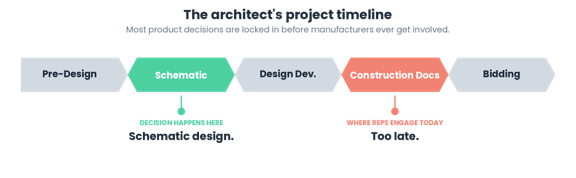
The specification document is the receipt for a decision that was made months earlier. By the time your product appears in Section 07 42 13, the basis of design is already locked. You are either the chosen product or an “or equal” defending against substitution.
The actual decision happens at schematic design, when the lead designer commits to a basis of design based on the firm's standards, the project's performance targets, and the client's aesthetic direction. If you are not present in that process, you are playing for second place.
There is a reason manufacturers default to the construction documents phase: it feels close to the order. The drawings are real, the bids are imminent, the rep can see a number. But that closeness is a trap. At construction documents, every spec listing comes with two alternates, and the conversation has moved from basis of design to basis of price. You stop being chosen and start being compared.
Engaging at schematic design is the opposite. It feels far from the order because the order is months away. But schematic is the only stage where you can shape the decision instead of respond to it. Working with an architect that early is like planting a crop in the spring: the harvest is months out, but the work you put in now determines what comes out of the ground. Manufacturers who tend that relationship through to construction documents almost always come out the other side as the basis of design.
Most manufacturer teams are organized around the construction documents phase, because that is when the rep finally gets a request. By then, the game is over.
03
Selling the product instead of solving the project.
Architects donot buy products. They solve projects. The rep who walks into a firm with ageneric capabilities deck is asking the architect to do the translation work:figure out which of your features apply to the rainscreen problem on theSeattle civic center, then build the case internally.
The rep whowalks in with a position on the project itself does the architect's job forthem. The climate. The LEED targets. The budget. The substrate compatibility.That rep gets specified. The other rep gets a polite thank-you.
There is aharder version of this discipline. Sometimes the project intelligence you bringwill reveal that your product is not the right fit for the requirements.
The rep who pushes the product anyway might win the spec, but at thecost of forcing a compromised solution onto the architect. The rep who tellsthe architect that the right product is a different one walks out without asale and walks back in for the next ten projects as a trusted advisor.
This is not a sales technique. It is a research problem. The manufacturer field teams with the project intelligence to walk in prepared are the ones winning specifications today.
One more thing: stop selling. Start advising. And be there when they need you.
The bestmanufacturer reps I know have stopped thinking of themselves as salespeople.They think of themselves as technical advisors to a small set of firms theyunderstand deeply.
The shift issubtle but consequential. A salesperson walks in pitching. An advisor walks inasking what the firm is working on, what they are stuck on, and where theirproduct might or might not fit. The advisor will tell an architect when acompetitor's product is the right choice for a project. That honesty is whatgets the advisor invited back for the next ten projects.
Responsivenessis the other half of this. Architects are working under deadlines that do notwait for product information. The rep who answers a technical question in anhour wins over the rep who answers in three days, every time. It does notmatter how good your product is if the architect cannot get an answer when theyneed one.
Advising andresponsiveness are not soft skills. They are the credentials of expertise. Thereps who have them become part of the firm's extended team. The reps who do notare interchangeable with every other rep selling something similar.
What the winners do differently
All threemistakes share a root cause. Manufacturers are still organized around the wrongmoment in the architect's workflow. Too late, too little context, the wrongsuccess metric.
Themanufacturers who win specifications today have rebuilt themselves around adifferent moment. They are present when the basis of design is being set. Theywalk in with project intelligence, not capabilities decks. They behave asadvisors, not vendors.
Theresult is being the firm's basis of design, project after project. That is theshift worth getting right.